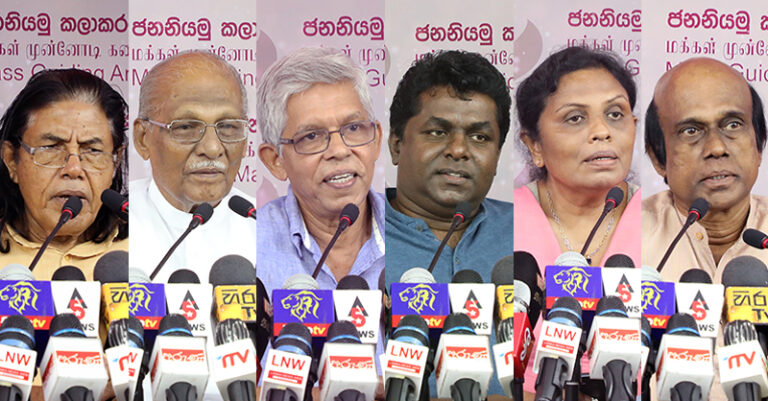
Mass Guiding Artists held a media briefing at the JVP Headquarters in Pelawatta, today (10th) morning to inform the media about the acute shortage of printing paper in the country.
Literary commentators, writers, publishers, critics and many others expressed their views.
History states that volumes were taken in procession on the head of a royal elephant – Literary critic Kamal Perera
“The paper question has now emerged as a serious question for the printer and the writer. As a result, the printing industry has been challenged and a reading situation that has existed since the distant history of our society has been lost. Reading a book is a cultural thing that is ingrained in society. It is said that during the reign of King Parakniramabahu, books were launched after they were carried on the back of the royal elephant. The book was called ‘Gajrantha Rajaya’. History tells us that lands were granted as gifts to creators and artists.
A society with such a history is in a serious situation with all the crises in the country today. Farmers are protesting without fertilizer. There is the cement issue, the gas issue, and now Panadol is not in the market. In such a situation, the paper shortage is a problem that affects not only the writer, publisher, printer and reader but also the whole society. The question of paper has affected literature to the point of shattering the spiritual life of the people. In such a situation, Mass Guiding Artists affiliated to the National People’s Power is holding this media briefing to educate the public.”
This world was changed by the knowledge gained from books – Writer & Counsel H.G. Punchihewa
“One may wonder whether discussing the shortage of paper is as important as the shortage of gas, cement and food in the country. On the surface, it feels not so important. But it is a very important question. People need ideas to solve even the food problem. Ways to get ideas are needed. World revolutions, uprisings, protests as well as agitations and dialogues all changed society. The knowledge gained from books has influenced the changing phenomena in the world. If you want to change this society you have to read books and get ideas. The Russian Revolution was embedded in the views expressed by all writers before the Russian Revolution. The same is true in France and China. First, the relevant ideological differences do not materialize without being reflected in the books. Gone are the days of changing the world through palm-leaf books, folklore and memories.
The production of paper for printing books is detrimental to the natural environment. But paper is needed to communicate knowledge about changing the world. The positive transformations that are reflected in literature, art, etc., take place in the world through the cognition of man. Otherwise, it will lead to a great cultural decline. That is why it is suggested that there should be paper for printing books. ”
Books represent human labour and culture – Literary scholar, publisher Mahinda Pirasad Masimbula
“Writer, publisher and printer have been challenged. We know that such situations have occurred throughout history. But at such an advanced age, I find this situation to be a strange thing. A book is the result of long human labour from where a writer thinks to write to what the reader can grasp. It is not just a collection of papers. On one hand, it represents culture. On the other, it represents human labour. From book printing to bookbinding, there are a number of job opportunities in the printing division. The current situation has affected all these jobs. Small printing presses and related workers are facing a lot of issues. This has affected the writer as well as the whole society in general.
In a country like Japan, many of their creative endeavours are intertwined with paper. They lay their creativity on paper with great respect and emotion. No matter how advanced modern technology is, they stick to paper, both in terms of creative work as well as education. But in this challenging time in our country, there is a serious question of how to face the future as a writer as well as a publisher. We must all work together to overcome this problem. It is not a good political instinct to treat folk culture in such an indecent manner. Therefore, we must all work together to overcome this challenge.”
What do you do if you have no paper to print textbooks? – Literary critic Keerthi Welisarage
“Recently we have seen the emergence of an uncultured society in our country. In response, we suggested that children be given the opportunity to read art and literature in addition to school curricula. We called for more opportunities for this. It was suggested that bridges be built through literature to alleviate the mistrust and intolerance of a multi-ethnic society. It was suggested that we translate Sinhala literature into Tamil and Tamil literature into Sinhala and apply both to English. We also suggested translating good English literary works into Sinhala and Tamil.
But like all other field landslides, the printing industry is in a state of turmoil. Although the literary community was hoping for a publicity expansion, now there is a contraction. All those who worked to change our society in the direction of achieving better cultural achievements are disillusioned today. The University of the Aesthetics has launched a book publishing project. However, only the first five books were published and the next five books were returned by the Government Printing Corporation. The reason is the shortage of printing paper. If so, what if they say there is no paper to write the next textbook? However, the government has not taken this situation seriously. The printing industry will be allowed to fall into the abyss just as other sectors were made to shrink. We emphasize to the government which is endangering our society on all sides and holding spectacles as if nothing had happened, that we condemn this serious attack on civilized human society. Therefore, we hope the public will wake up and take action.”
Losing the ability to even read a newspaper – Literary scholar D.V. Gallage
“Even before this situation arose, we, with our organizations, were involved in getting the taxes imposed on the printing industry reduced. But now it has gone beyond other questions and the issue has degenerated into a situation where importing printing paper has been stopped and the import of other printing materials suspended. As a result of the current crisis, the printing industry and literature are being severely threatened. Dr Nimal Sandaratne in an economic article in a newspaper states that last year was the worst year we have had since 1948.
Mr. JR Jayewardene, during his presidency, had asked what literature can do to life. It is a great pity that a crisis has arisen in the literature that has not existed even in such an era. Enjoying the art of literature is essential to make people, cultural people, into a capitalist society. For this purpose literary books are widely used by people. Also, a part of cognitive development has been assigned to the book. The only way to do that is now disappearing. So we as artists and writers are shocked. One wonders why talk about literature when people are on the verge of starvation. But we especially urge the public to understand that books are as essential as agitating for rice, coconut, dhal, chilli and condiments. We ask that you take the paper issue to the forefront of your campaigns and demands. There is a situation now where even the minimum facilities to look at a newspaper are being lost. We learn that the government’s Lake House has only enough paper to print newspapers till next June. If the situation even for a large corporation like Lake House is thus, what can we say about other small institutions?”
Closing down a printing press is like closing a school or a university – Vipuli Niroshani Hettiarachchi – Children’s book writer, teacher, poet
“One hundred printing presses will be closed. Will the printing industry shut down?” I saw this news in a newspaper. I was reminded of the story that when a school closes, ten prisons open. It’s a story that touches my heart. Closing a printing press is like closing a school or a university. That means 10 prisons will be opened. Is the shortage of paper just another shortage like that of gas, milk powder and cement? The printing industry is a milestone in human civilization. Written communication is confronted with a serious challenge. Literary appreciation and the education of children have come across a severe challenge. That is something that everyone should take into consideration.
If the shortage of paper causes high prices for paper, the printing industry is likely to collapse. A paper lot that can cost Rs. 5,000 will cost another Rs. 2,000 to Rs. 3,000 in the future. How will it affect small printers and education textbooks publishers?
Due to the covid situation, children are turning to online education. By now we know how complicated it is. It is not a successful, effective situation. Picking up a book in such a situation is a step towards the mental development of children. It is not enough to feed the children but a book is essential for mental development. How important a book is to children’s imagination. The book is extremely important to children. Educational decision-makers and textbook editors need to be prepared for this paper shortage.
It is very important to provide extra reading books for children. Even now it is not happening in a sound manner. What will happen to the education and future of our children if there is a shortage of paper in such a situation? If a situation arises where our children have to read books on their smartphones and the internet, we have to think carefully about what the future implications would be. Therefore, I am ready to raise my voice at any time in this regard.”
Comments are closed