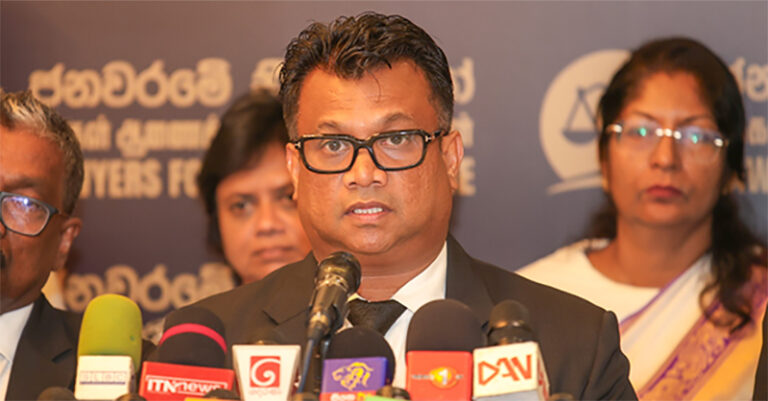
Attorney Akalanka Ukwatta emphasized that Sri Lanka is already late in raising the retirement age of judges when compared with international standards and practices in other countries.
He expressed these views while addressing a media briefing organized by the ‘Lawyers for People’s Mandate’ (Janavaramaye Nithignayo) in Colombo July 29.
Further speaking at the conference, Attorney Akalanka Ukwatta stated:
“As ‘Lawyers for People’s Mandate’, we are holding this press conference to clarify the mandate given by the people of this country in 2024, how the current government is acting in accordance with that mandate, and how the proposed constitutional amendments align with it.
The people gave a mandate to the current President and 159 Members of Parliament. The core and subtle essence of this mandate is to establish the rule of law in a country that had devolved into a crime-ridden state. It involves conducting proper judicial proceedings to investigate crimes, including corruption and drug trafficking, and punishing the offenders. To further activate this public expectation, the government is planning a constitutional amendment to fulfill these public hopes effectively. According to Article 107(V) of the Constitution, the Cabinet has approved proposals to increase the retirement age of Court of Appeal judges from 63 to 65 and Supreme Court judges from 65 to 67. Additionally, it is proposed that the retirement age of the Chief Justice be set at 67 or a maximum tenure of six years in office.
Furthermore, an amendment to Article 137 proposes increasing the number of judges in the Court of Appeal to 25. As ‘Lawyers for People’s Mandate’, we have gathered to provide further clarity on these government actions aimed at fulfilling the mandate’s requirements. Under the 20th Amendment to the Constitution, the bench strength of the Court of Appeal and Supreme Court was raised without much debate. Now, to strengthen the administration of justice for the people in a visible manner, steps are being taken to amend the 46-year-old Article 107(V).
Over time, retirement age limits for judges have been raised in many other countries: Australia is set at 70, Canada at 75, Brazil at 75, Denmark at 73, Iceland at 70, Japan at 70, Sweden at 69, and Switzerland at 68, while the USA has no upper age limit. Oliver Wendell Holmes, historically known as one of the oldest serving American jurists, highlighted the necessity of maintaining higher age limits to retain experienced judges in service. In the UK, the retirement age was set at 75 in 1959 (prior to which there was no limit), reduced to 70 in 1993, and then raised back to 75 in March 2022 after 27 years. Legal expert Robert Buckland, who played a key role in this increase, explained that the world-renowned excellence, expertise, and independence of their judges, magistrates, and coroners are sustained by utilizing their valuable experience through higher retirement limits.
In South Africa, there was no retirement limit as of 1910; in 1989, a limit of 70 years alongside a maximum tenure of 12 years was introduced, with provisions allowing service up to age 75 if the 12-year term is incomplete. In France, although President François Mitterrand reduced the general civil service retirement age from 65 to 60 in 1982, the retirement age for judges was left untouched and was later raised to 67 in 2010, with the Chief Justice’s limit extended to 68. These global experiences clearly demonstrate that Sri Lanka is already late in adopting this trend. Following Cabinet approval, it is evident that extending this retirement age is a necessity aligned with the people’s mandate.
To ensure this age extension applies to primary courts as well, steps are being taken to amend the Judicial Service Act. Accordingly, the retirement age of High Court judges will be increased from 61 to 63, and for Magistrates and District Judges from 60 to 62. These amendments to the Judicial Service Act and the Constitution will be carried out concurrently, ensuring that age limits do not hinder lower court judges from being promoted to higher courts, a move that has already gained strong public endorsement.”