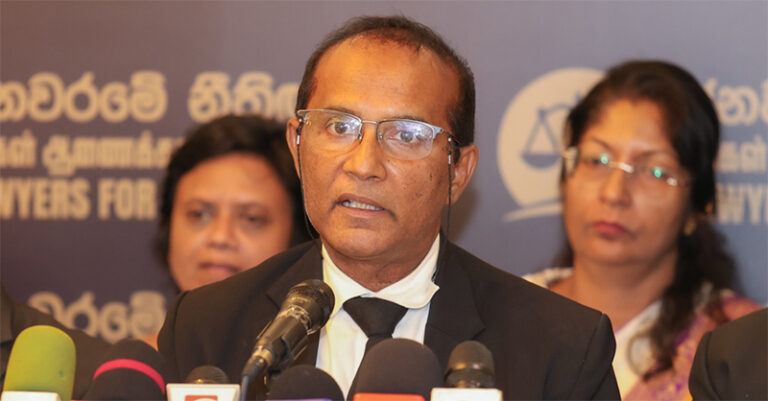
Attorney Hemaka Senanayake emphasized that, unlike previous administrations, the current government is not an authoritarian one. He made these remarks while responding to questions posed by journalists during a press conference organized by the ‘Lawyers for People’s Mandate’ (Janavaramaye Nithignayo) in Colombo on July 28.
Elaborating further during the briefing, Attorney Hemaka Senanayake stated:
Question: The government has been given a two-thirds public mandate to make necessary legal amendments. If so, why are some parties getting agitated? And why do you seem concerned about their agitation?
Answer: “We are not agitated at all. Unlike previous governments, this is not an authoritarian government. However, both you and we have past experiences with previous regimes. There was a past where a case involving a politician in the Kesbewa area was withdrawn just three days before the verdict was due to be delivered. Furthermore, we remember how the 8th Executive President referred to decisions handed down by the Honourable Supreme Court as ‘judicial barbarism.’ We recall discussions about appointing a Parliamentary Select Committee to punish Supreme Court judges over their rulings. We also remember how stones were thrown at the official residences of judges following the ruling on the Vivienne Goonewardene case.
The National People’s Power (NPP) government is actively working to transform this background entirely. The political culture has been changed to a point where not even the slightest post-election violence occurs after an election.
What is being prepared now is another step in that direction. The journalist who asked the question might think that with the Executive Presidency and a parliamentary majority of 159 seats, this bill could easily be passed overnight. However, this government has provided room for criticism in a very democratic manner. The only thing that cannot be allowed is acts of sabotage. As one of our attorneys pointed out, if those who oppose this amendment present valid reasons for their opposition, we are ready to listen. This government is not prepared to take an arbitrary or authoritarian path.
Question: During a media briefing, Mr. Shiral Lakthilaka stated that while he does not oppose extending the retirement age, there is an issue with the procedure being used to introduce these amendments. Is there such an issue?
Answer: “We convened this press conference not to answer individuals, but to clarify facts to the public. If someone claims there is a flaw in the procedure, they must also explain what the correct procedure should be. What constitutes people’s sovereignty is clearly specified in Articles 3 and 4 of the Constitution. Similarly, Articles 105 and 106 define the courts, while Articles 107 through 117 outline the independence of the judiciary. Among these provisions, Article 107(V) is what is proposed to be amended.
All Honourable Judges in the superior courts and primary courts render an exceptional service. Considering the public interest, what is being asked is for them to extend this excellent service by another two years.
The public recognized that due to prolonged fraud, corruption, and theft by politicians in this country, they were left unable to secure even essential goods needed for daily life. That is why they gave a mandate demanding a system change. To implement that mandate, the judiciary must function directly and independently. We cannot repeat situations like the politician’s case in Kesbewa, stone-throwing at judicial residences, or statements labeling rulings as ‘judicial barbarism.’ It is on this foundation that the amendment is being brought to extend the service of Honourable Judges by two years. If this method is wrong, please explain the correct process to us.
Let me offer an example: the Wayamba Province only has the Kurunegala Provincial High Court. The North Central Province only has the Anuradhapura High Court. Uva only has Badulla, and the Central Province only has Kandy. There are currently only 93 High Court judges available. Some judges are serving in two court locations simultaneously—for instance, one judge served at both the Ampara and Badulla High Courts. Although the required number of High Court judges is 110, there are only 93 serving at present. Proposals have been made to increase this number to 120 and grant promotions accordingly. Additionally, the number of Court of Appeal judges is expected to be increased from 20 to 25. Raising the retirement age limit is merely one component of these broader reforms. It is our view that this is the correct approach to implementing the people’s mandate of 2024.”