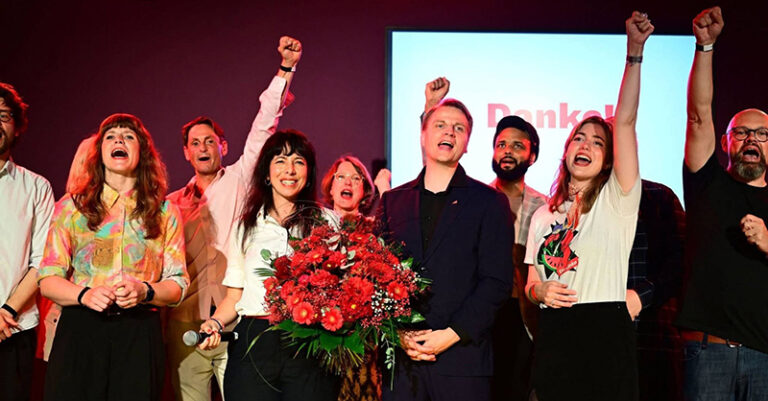
BERLIN – In a major political shift ahead of Germany’s upcoming parliamentary elections, Elif Eralp of the left-wing Die Linke party secured victory in the Berlin election held on Sunday, September 20, 2026. Securing roughly 25% of the vote, Eralp outperformed both the ruling Christian Democratic Union (CDU) and the Social Democratic Party (SPD), as well as the far-right Alternative for Germany (AfD).
Eralp, a 45-year-old human rights lawyer of Turkish descent, campaigned strongly on tackling Berlin’s severe housing crisis and rising cost of living. Her victory offers renewed hope to left-wing movements across Europe, with analysts viewing it as a clear signal that voters are rejecting traditional establishment parties as well as far-right politics in favor of progressive alternatives.
Speaking on her victory, Eralp credited her parents—a Turkish trade unionist father who fled to Germany in 1980 and her mother—for instilling values of resilience:
“I thank my parents for inspiring in me the values never to give up, to stand up again and again, and to stay in the struggle until everyone’s voice is recognized.”
Path to the Mayoral Office and Housing Reforms
To officially assume office as Berlin’s first radical left-wing mayor and the first mayor with a migrant background, Eralp must form a coalition with the Social Democrats (SPD)—who suffered their worst historical result with 12%—and the Greens, who garnered 15%.
A central pillar of Eralp’s platform is addressing Berlin’s housing shortage by expropriating approximately 270,000 vacant properties owned by large corporate real estate firms to bring them into public ownership. While the Green Party supports the initiative, SPD candidate Stefan Krach expressed reservations during debates, citing potential costs estimated between €20 billion and €30 billion.
A New Generation of Left Politics
Born in Munich in 1981, Eralp practiced law focusing on migrant rights before joining Die Linke, a party rooted in East Germany’s former SED. Political analysts have drawn comparisons between Eralp and international figures like New York politician Zohran Mamdani, noting that both represent a new generation of left-wing leaders prioritizing housing affordability, youth issues, and social equality over traditional austerity.
Addressing criticisms regarding her party’s strong stance in defense of Palestinian rights, Eralp firmly rejected allegations of antisemitism, reiterating her commitment to protecting Jewish life in Berlin while opposing anti-peace policies and holding all actors accountable under international law.
Eralp’s victory in Berlin stands in contrast to election results in the eastern state of Mecklenburg, where the far-right AfD secured 37% of the vote. Political commentators suggest that strong, alternative left movements like Eralp’s may prove to be the key counterweight to the rise of far-right nationalism in Germany and across Europe.